130 Years of Brazil–Japan Relations: History, Trade, and What Lies Ahead
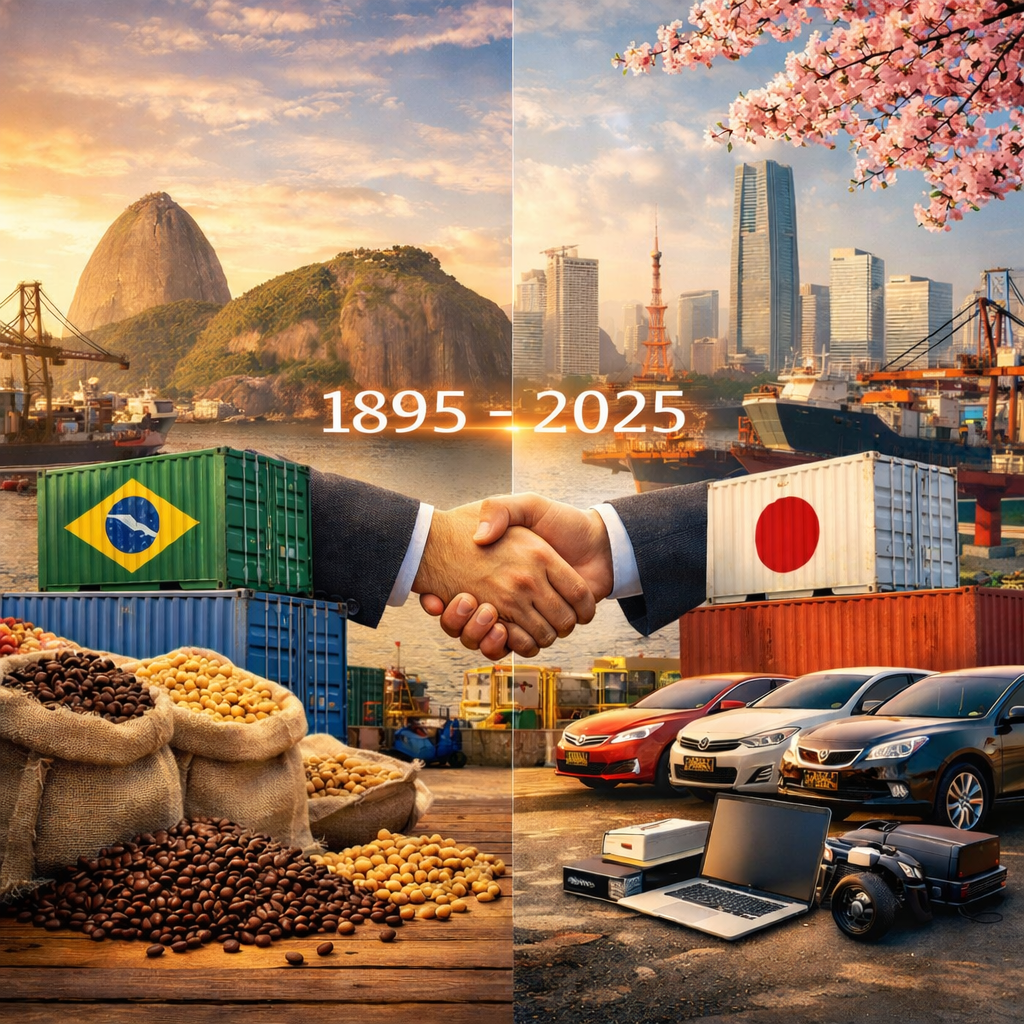
In 2025, Brazil and Japan completed 130 years of diplomatic relations. The starting point was the Treaty of Friendship, Commerce and Navigation, signed in Paris on November 5, 1895. That agreement opened the door to an exchange that went far beyond diplomacy and quietly shaped the history of both countries.
A relationship built by people
The formalization of 1895 was only a starting point. The chapter that defined the relationship came in 1908, when the Kasato Maru docked at the port of Santos carrying the first Japanese immigrants to Brazil. Over the following century, that community put down roots deep enough that Brazil is now home to the largest Nikkei population outside Japan. The current runs the other way too: hundreds of thousands of Brazilians live and work in Japan. This back-and-forth movement of people is what gives the bilateral relationship its real texture.
The path was not always smooth. The Second World War severed the dialogue entirely, and rebuilding trust took years. But the recovery was genuine. By recent decades, the two countries had formalized a Global Strategic Partnership covering politics, economy, science and technology.
Trade today: complementarity that works
The commercial logic between Brazil and Japan is fairly straightforward. Brazil sends commodities: iron ore, poultry, coffee, pulp, aluminium. Japan sends industrial goods and technology: auto parts, machinery, electronic components. Neither side is trying to be what the other already is.
In 2024, bilateral trade came to roughly US$11 billion. Brazil held a small surplus. Agricultural products and natural resources anchored the Brazilian side; Japanese manufactured goods dominated the reverse flow. Japan sits consistently among Brazil's top trading partners in Asia, relevant both for commodity volume and for specific sectoral opportunities that rarely get enough attention.
2025: a year of celebration
The 130th anniversary generated events across both countries that reflected the depth of what has been built. Cultural festivals, academic seminars and professional exchanges took place in cities throughout Brazil. Institutions like the Sociedade Brasileira de Cultura Japonesa (Bunkyo) brought Japanese art, music and tradition into conversation with Brazilian culture in ways that no bilateral trade agreement could manufacture.
On the business side, forums and cooperation memoranda produced new introductions and commitments. The point that kept coming up: this relationship is not reducible to trade statistics.
Where the opportunities are
For practitioners in the Brazil–Japan corridor, a few things deserve close attention over the next decade.
Commodities will remain central to Brazilian exports, but the ceiling for value-added products is higher than it has been. Quality processed foods, manufactured goods and technology transfers are all areas where the structure of demand in Japan aligns with Brazil's growing productive capacity. Japan, for its part, has strong incentives to deepen cooperation in industrial automation, clean energy and life sciences with a country of Brazil's scale and resource endowment.
Joint projects in precision agriculture, renewable energy and robotics are no longer speculative. The environmental agenda has created shared language between the two governments, and low-carbon solutions are becoming a legitimate area of bilateral cooperation rather than a diplomatic talking point.
Geography remains the persistent challenge. The Pacific is wide, and logistics costs eat into margins on both sides. Port improvements, supply chain digitalization and streamlined customs procedures are the unglamorous work that makes competitive trade possible. Progress here compounds over time.
The communities themselves are an underutilized asset. Millions of Nikkei live in Brazil. Hundreds of thousands of Brazilians live in Japan. These are people who understand both sides without needing an interpreter, in more than one sense. Investing in academic and professional exchange deepens the trust that makes long-term partnerships work.
A legacy that points forward
One hundred and thirty years is a long time. The relationship between Brazil and Japan has survived wars, economic crises and dramatic shifts in both countries' circumstances. What remains is a foundation: real complementarity, deep human ties, and a track record of getting past the hard moments.
For those working this corridor now, the conditions are as good as they have been. The opportunities are concrete. The question is who moves on them.
Stay Informed
Japan–Brazil Trade Insights, delivered.
New articles on trade, culture, and market opportunities, straight to your inbox. No spam.